
Smartprep Special Needs Therapeutics
Smartprep Special Needs Therapeutics
Published: 12/5/2026
Let us be honest.
Supporting an autistic child is not something you handle with guesswork.
You may love the child deeply. You may be patient. You may even have passion for special needs education. But when you enter a real autism therapy session and the child is crying, running around, refusing tasks, avoiding eye contact, not responding to name, throwing materials, struggling with communication, or having sensory overload, passion alone will not be enough.
That is where practical autism intervention training becomes very important.
At Smartprep NeuroBridge, the training program of SSNT, we created the Professional Certificate in Autism Intervention Therapy for one major reason: many parents, teachers, caregivers and emerging SEN practitioners in Nigeria are willing to support autistic children, but they do not always know exactly what to do during real-life sessions.
And that is a serious gap.
Autism Support in Nigeria Needs More Than Awareness
In Nigeria today, autism awareness is growing. More parents are beginning to notice developmental differences early. More schools are receiving children with autism. More caregivers are being asked to support children with communication, behaviour, sensory and learning needs.
But awareness is only the beginning.
Knowing that a child is autistic is not the same as knowing how to support the child.
A teacher may know that a child has autism but still not know how to manage classroom behaviour.
A parent may know that their child needs therapy but still feel confused about what to do at home.
A caregiver may be assigned to support an autistic child but may not understand sensory overload, meltdowns, communication difficulties, transitions, or emotional regulation.
An emerging SEN practitioner may have attended different trainings but still feel unsure during practical sessions.
This is why a practical Autism Intervention Therapy Course in Nigeria is needed.
Not just another course filled with big grammar.
Not just another certificate that sounds nice.
But a course that shows you what to do, how to do it, when to adjust, and how to know whether progress is happening.
Why Autism Intervention Can Feel Difficult
Autism intervention can feel overwhelming because one child may present with many needs at the same time.
For example, you may be working with a child who:
1. does not use words to communicate;
2. cries when routines change;
3. refuses to sit for learning activities;
4. covers the ears because of sound sensitivity;
4. puts objects in the mouth;
5. runs away during sessions;
6. struggles with feeding;
7. avoids social interaction;
8. becomes aggressive when demands are placed;
9. cannot cope in a classroom setting.
Now imagine trying to address all these in one child.
That is why many practitioners feel pressure.
It is not because they are lazy.
It is not because they are not passionate.
Most times, it is because they do not yet have a clear intervention structure.
They need practical guidance.
They need to understand how to observe the child, identify the main support needs, set realistic goals, choose the right strategies, and troubleshoot when things are not working.
That is exactly what this course is designed to do.
About the Professional Certificate in Autism Intervention Therapy.
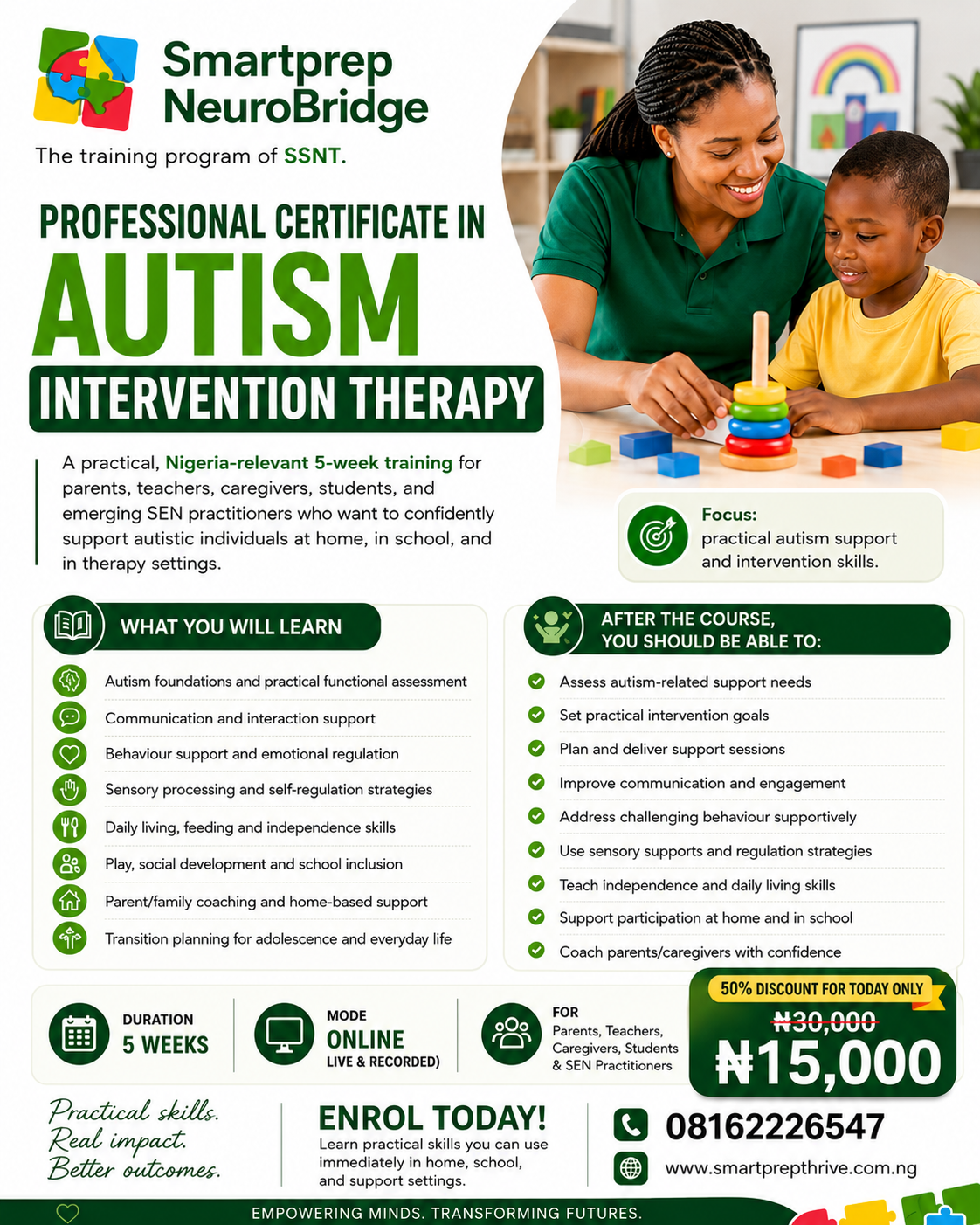
The Professional Certificate in Autism Intervention Therapy is a practical 5-week online training designed for people who want to confidently support autistic individuals at home, in school, and in therapy settings.
It is suitable for:
Parents of autistic children.
Teachers working with neurodivergent learners.
Caregivers and shadow teachers.
Students who want to enter the special needs field.
Emerging SEN practitioners.
Therapy assistants.
School owners and inclusion coordinators.
Anyone who wants to understand autism support in a practical way.
The course is self-paced, and learners also receive access to structured course materials that can guide their learning and practice.
After successful completion, participants receive a certificate, training manual, and course transcript.
What Makes This Autism Training Different?
The major difference is that this course is built around practical autism intervention, not just autism information.
There are many people who can define autism.
But in real sessions, the question is not just, “What is autism?”
The real question is:
What do I do when the child refuses to engage?
What do I do when the child cannot communicate?
What do I do when the child has a meltdown?
What do I do when the child keeps running away from tasks?
What do I do when the child cannot cope in school?
What do I do when parents are overwhelmed?
What do I do when my strategy is not working?
This course focuses on those real questions.
It is structured to help learners move from confusion to clarity, and from random trial-and-error to guided intervention.
What You Will Learn in the Autism Intervention Therapy Course
1. Autism Foundations and Practical Functional Assessment
You will learn how to understand autism beyond labels.
This includes how to observe the child, identify strengths and needs, understand behaviour patterns, and know where to begin support.
Functional assessment is important because you should not just intervene blindly. You need to know what the child is struggling with, what may be triggering the behaviour, and what support the child needs first.
2. Communication and Interaction Support
Many autistic children struggle with communication, but communication is not only about speaking.
Some children communicate by pointing, pulling adults, crying, using gestures, using pictures, repeating words, or avoiding tasks.
In this course, you will learn how to support communication in practical ways. This includes requesting, attention, engagement, imitation, turn-taking, early speech attempts, non-verbal communication and functional communication.
The goal is to help the child communicate needs better and reduce frustration.
3. Behaviour Support and Emotional Regulation
Challenging behaviour is one of the biggest concerns in autism support.
But behaviour is not just “stubbornness.”
Sometimes, behaviour is a message.
A child may be trying to escape a difficult task, get attention, access an item, avoid sensory discomfort, or express confusion.
This course teaches you how to understand behaviour, identify possible triggers, reduce pressure during sessions, teach replacement behaviours, and support emotional regulation in a calm and professional way.
4. Sensory Processing and Self-Regulation Strategies
Many autistic children experience the world differently through their senses.
Some are sensory-seeking. They may jump, spin, touch everything, mouth objects, or crash into furniture.
Some are sensory-avoidant. They may cover their ears, avoid certain textures, reject foods, cry in noisy environments, or resist touch.
Some may shut down when overwhelmed.
In this course, you will learn how to identify sensory patterns and use practical sensory supports before and during sessions.
This is very important because a child who is not regulated may not be ready to learn.
5. Daily Living, Feeding and Independence Skills
Autism intervention is not only about table work.
Real progress also includes everyday life skills.
You will learn how to support independence in areas such as feeding readiness, dressing, toileting routines, hygiene, simple home routines, task participation and self-help skills.
These are the skills that make life easier for the child and family.
6. Play, Social Development and School Inclusion
Play is not just for fun. For many autistic children, play can become a pathway to communication, connection, imitation, turn-taking and social participation.
This course teaches how to use play intentionally.
You will also learn how to support school inclusion, classroom participation, peer interaction and better adjustment in learning environments.
This is especially important for teachers, school owners, shadow teachers and inclusion support staff.
7. Parent and Family Coaching
Autism support does not end when the session ends.
Parents and caregivers need guidance too.
This course helps learners understand how to coach families with simple strategies, realistic expectations and practical follow-up activities they can continue at home.
A child makes better progress when home, school and therapy support are connected.
8. Transition Planning and Everyday Life Support
Many autistic children struggle when moving from one activity to another.
For example, moving from play to learning, from home to school, from screen time to bath time, or from one classroom activity to another can lead to crying, refusal or meltdown.
You will learn practical ways to prepare the child for transitions, reduce anxiety, build routine tolerance and support everyday participation.
Who Should Take This Course?
This course is for you if you are a parent who wants to understand your child better and support progress at home.
It is for you if you are a teacher who has autistic learners in your classroom and you want to stop feeling helpless.
It is for you if you are a caregiver or shadow teacher supporting a child with autism and you want to become more effective.
It is for you if you are an emerging SEN practitioner who wants practical autism intervention skills.
It is also for you if you run a school, therapy centre or learning support program and you want your staff to become more confident in autism support.
Why Practical Autism Training Matters
Autistic children do not need adults who only know the theory.
They need adults who can observe carefully, respond calmly, teach patiently, adjust strategies, and support them with dignity.
Practical autism training helps you know what to do when sessions are not going as planned.
It helps you stop blaming the child.
It helps you stop blaming yourself.
It helps you understand that progress may be small, but it must be intentional.
One child may learn to request water.
Another may learn to sit for two minutes.
Another may begin to tolerate a new food.
Another may reduce hitting because they now have a better way to communicate.
Another may finally join a classroom activity without crying.
That is progress.
And progress becomes easier to track when you know what you are doing.
Course Duration, Mode and Access Fee
The Professional Certificate in Autism Intervention Therapy runs for 5 weeks.
Mode: Online.
Format: Self-paced, live and recorded.
This gives parents, teachers, caregivers, students and SEN practitioners an affordable opportunity to build practical autism support skills without waiting until they can afford very expensive training.
What You Receive After the Course
After successful completion of the course, you receive:
A certificate.
A training manual.
A course transcript.
These documents help show your learning effort, your completed training areas, and the practical knowledge you have gained.
Our Refund Confidence Promise
We believe strongly in the practical value of this course.
If you take this course, complete all course activities, apply the practical steps taught, submit your session reflection, and still do not experience any tangible improvement in your autism support sessions — or at least 5 out of 10 grey areas in your sessions are not properly addressed — then you can request a full refund of your access fee.
And yes, that refund will come with an apology from us for wasting your time.
This is because we are not just selling access.
We are offering practical guidance that should help you become better, clearer and more confident in autism support.
Final Word
Autism intervention is not for the weak, but it is also not impossible.
You do not have to keep feeling confused in your sessions.
You do not have to continue guessing what to do.
You do not have to wait until you know everything before you start supporting children better.
What you need is structure.
What you need is practical exposure.
What you need is guidance that connects autism knowledge to real-life support.
That is what the Professional Certificate in Autism Intervention Therapy is designed to give.
If you are ready to improve your autism therapy sessions, support autistic children better, and become more confident in practical autism intervention, this course is for you.
Enrol today and take the next step.
Smartprep NeuroBridge
The training program of SSNT.
Empowering minds. Transforming futures.
Johnny Akpojaro
Founder and Lead Facilitator, Smartprep Special Needs Therapeutics, Abuja/Smartprep NeuroBridge.
www.smartprepthrive.com.ng | +234 8162226557(whatsapp only)